Thousands of students at risk of suffering from extreme heat in Paraguay
We created a map showing that hundreds of educational institutions in Asunción and Central without bathrooms, water or fans are located in heat islands.
Consenso publishes today an exclusive investigation into the lack of infrastructure and the risk of heat islands for hundreds of educational institutions and thousands of students and teachers in Asunción and Central.
Through the analysis of satellite images and official data , we created an interactive map that indicates the risk of heat islands in schools and colleges that start classes with a deficit of bathrooms, drinking fountains, electricity, fans and air conditioners.
95% of these educational institutions are located in heat islands ranging from moderate to extreme.
Consenso realizó este trabajo gracías al apoyo solidario de suscriptores y suscriptoras. Sumate y hacé tocorré.
There are 759 educational institutions located in Asunción and Central with infrastructure deficits that are at moderate to extreme risk due to temperatures worsened by climate change in Paraguay, one of the hottest countries in the world right now.
In turn, at least 115,316 children and adolescents in Asunción and Central are in schools and colleges with problems of access to water, electricity or ventilation in heat islands.
An urban heat island is a phenomenon that occurs in a specific location where the temperature is higher than average due to:
a) More cement and less green: where cement and concrete - such as that of gas stations and supermarkets - have been replacing forests and other green areas that provide not only shade, but also natural cooling of the soil.
Buildings and asphalt absorb heat during the day and release it more slowly at night.
b) Tall buildings and narrow streets: the construction of high-rise buildings - as in the Santa Teresa area - and narrow streets - as in the center of Asunción - reduces the possibility of wind.
The air is trapped and heats up, worsening the feeling of high temperatures. Furthermore, buildings with glass windows can reflect sunlight onto the ground, creating a magnifying glass effect.
c) Air conditioning and pollution: Hundreds of thousands of air conditioners roar in the cities of Paraguay.
While they’ve become essential for surviving unusually hot weather, they do so at the cost of expelling hot air outside. This creates a vicious cycle where more air conditioning is needed because the heat feels even worse.
Another problem is air pollution from vehicles and fires, which trap solar radiation.
Many educational institutions in Paraguay have lost shade due to the need to build more classrooms or the uncontrolled urban growth in Asunción and Central. Others are buildings designed for a world of 40 years ago, with temperatures that no longer exist.
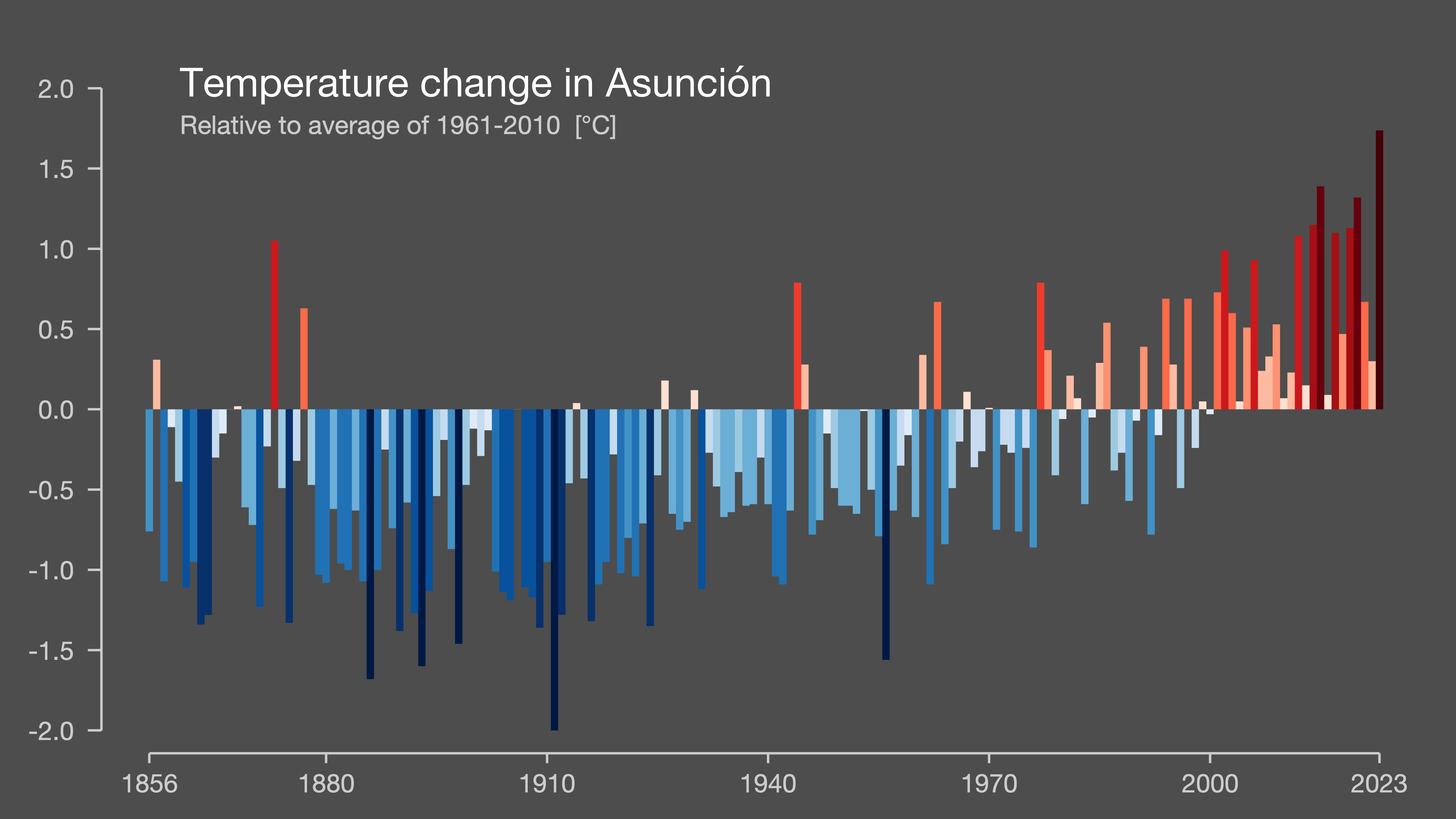
The country, which already suffers from the largest increase in average temperature in the last two decades in Latin America according to the Lancet Countdown, is also faced with an underfunded education system that is unable to fulfill its promise of reducing inequalities.
This is compounded by insufficient investment in infrastructure in general and in adaptation to climate change in particular.
According to official data, the country received only 0.87% of what it needs to prepare for the impact of increasingly higher temperatures that affect everything from local economies to access to education.
The nation’s capital has the highest number of schools with infrastructure deficits in the face of climate change, which in turn are located in high- to extreme-risk heat islands.
It is important to understand that a building may house more than one educational institution - or that several consecutive reports of infrastructure needs were made in 2024 for the same institution.
Although these cases are statistically rare, we have decided to leave them in order to respect the integrity of the official data.
More than half of the institutions with infrastructure deficits in high to extreme heat islands need to repair or build toilets for their students and teachers.
In an upcoming edition of the newsletter, we will analyze case studies, such as the impact of fuel station construction on the increase in average temperature around where thousands of children attend school.
This special was produced by Consenso (2025). The content of this project is licensed under the Creative Commons Attribution Share Alike 4.0 International License, and the project’s source code is licensed under the MIT License.